
The Cascade of Care Bottlenecks: What Workforce Shortages Mean for Baby Boomers Seeking Care

This article is part two of a series on the consequences and impact on healthcare as baby boomers turn 80. Click here to learn more about the series.
As Michigan’s population ages, more people will need access to medical, emergency, pharmacy, and long-term care, as well as care coordination across those services.
Workforce shortages are already contributing to access challenges. New patients in Detroit have faced waits of up to 58 days for a Family Medicine Physician appointment.
For older adults, gaps in care can lead to worsening health, medication disruptions, reduced independence, and preventable emergencies.
Families often fill those gaps: 31% of Michiganders aged 50 and older care for an adult family member or friend with a health issue or disability.
Demand continues to grow. Michigan is estimated to need nearly 147,000 additional Home Health and Personal Care Aides by 2035.

Meet Rosalind. She, like thousands of Baby Boomers, just turned 80. And just like many of her Baby Boomer counterparts, she has been living with hypertension and type 2 diabetes for many years. Managing her multiple chronic conditions (MCCs) has meant Rosalind frequently visits her local doctor’s office. That is another thing she has in common with seniors 65+: more frequent doctor’s visits. Seniors 65+ visit the doctor's office at rates 1.89 times higher than those of adults 45-64 and 3.77 times higher than those of adults 18-24.
Living with hypertension and type 2 diabetes also means an additional barrage of specialist appointments: a Cardiologist, an Endocrinologist, and a Nephrologist. That’s not even mentioning the frequent visits to the Pharmacist for prescription pick-ups and refills.
Rosalind is tired. She is tired of all the appointments. She is tired of the lack of communication and even more tired of the conflicting information she receives at each appointment. She wants to enjoy her old age, but her health has become the focal point dictating her daily activities.
In this second part of the Baby Boomer series, we will follow Rosalind’s journey as she navigates Michigan’s healthcare system from her hometown of Detroit. While Rosalind is a fictional person, the struggles and barriers she faces reflect the real consequences of an ill-equipped, understaffed, and complicated healthcare system.
The Physician Visit | The Referral Chain Begins

Rosalind sat on the bus, replaying her appointment in her head. She had to wait a month to see her Primary Care Physician about her worsening vision, which she feared was tied to her diabetes—an ongoing struggle of dysregulation since her Endocrinologist had retired two years ago. Her pharmacy had also shut down. And while Rosalind was trying, and failing, to transfer her prescriptions to a new pharmacy, her hypertension medication had run out… But the primary care visit quickly shifted to the fall she had yesterday, when her blurry vision sent her off balance in her kitchen.
The Physician had arrived in the small appointment room 30 minutes late. After a quick apology about being overbooked, the Physician jumped right into why Rosalind was there. No time for small talk with such a full schedule. Rosalind felt he rushed through the appointment and just sent her off with another list of referrals: another Endocrinologist, an Orthopedic Surgeon, and a Physical Therapist. He barely had time to assess her vision, and she left without knowing whether she needed an eye specialist or something else for her diabetes.
Back on the bus, Rosalind rested against the window. More appointments. More waiting. She felt like she had more questions now than answers.
Rosalind’s experience is a preview of what is becoming increasingly difficult to avoid across Michigan: primary care shortages are making it harder for patients to access timely, coordinated care. That strain is already showing up in wait times, provider pipelines, and access gaps that are especially acute in rural parts of the state.
Projections from the National Institute for Health Care Management (NIHCM) estimate that by 2037, over 40 states will face primary care provider (PCP) shortages. Michigan is already feeling the impact. Family Medicine residency slots are going unfilled, and health systems are struggling to attract new Physicians into the field. Recent residency results illustrate the recruitment challenges. In 2026, only 200 of Michigan’s 264 Family Medicine residency slots (75.8%) were filled through the National Resident Matching Program’s Main Residency Match, also known as “Match Day”.1 The percentage of filled slots has decreased every year over the last five years.
Those shortages are showing up in the exam room. In AMN Healthcare’s 2025 Survey of Physician Appointment Wait Times and Medicare and Medicaid Acceptance Rates, new patients in Detroit faced waits of up to 58 days to see a Family Medicine Physician. Wait times for specialists in Detroit were even longer, reaching up to 208 days to see a Gastroenterologist. For older adults living with MCCs, that kind of delay can mean more urgent care visits, worse chronic disease management, and higher health costs. In a recent survey from the American Association of Nurse Practitioners, nearly half of the people who experienced long primary care wait times said they gave up trying to get an appointment and ultimately received no care.
Access issues are not evenly distributed. Rural communities are expected to bear the brunt, and many parts of Michigan already show signs of severe primary care shortages. When the workforce thins, patients like Rosalind are left waiting longer for care that becomes more urgent by the day.
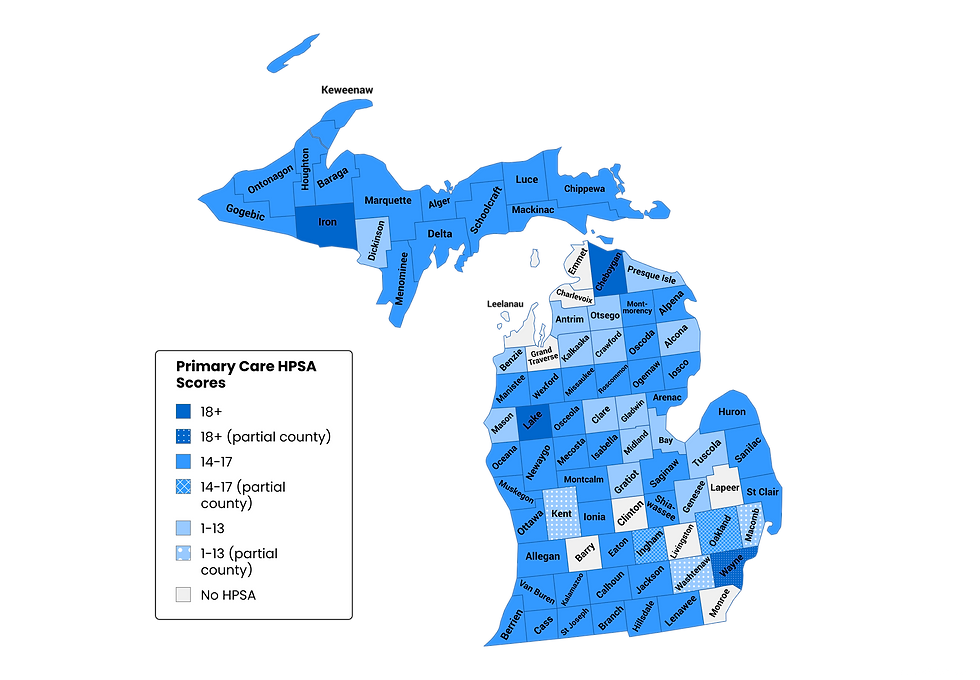
The higher the HPSA score, the more severe the shortage. Primary Care HPSAs receive a score between 0 and 25, calculated based on the population-to-provider ratio, the percent of the population below 100% of the federal poverty level, newborn health outcomes (either infant mortality rate or low birth weight rate), and travel time to the nearest source of care outside the HPSA designation area.
Because Baby Boomers are likely to have two or more MCCs, their care needs are often complex. A single appointment may need to cover several symptoms, medications, treatment plans, and referrals. That complexity collides with a healthcare system built around short visits and limited provider availability. A recent study found that providing truly guideline-based care for patients with MCCs would require an impossible 27 hours of work in a single day. Yet appointments often last just 15 to 30 minutes. That kind of system shifts additional scheduling and care coordinator responsibilities onto patients and any caregivers they may have.
For people with type 2 diabetes, the loss of an Endocrinologist can make care even harder to manage. Nationally, Endocrinologists are in shorter supply as older Physicians retire and fewer medical students enter the specialty. That can leave older adults with diabetes more vulnerable to mismanagement, complications, and emergency care. The stakes are especially high because older adults with type 2 diabetes face a greater risk of falls and injury, making timely specialty care essential to preserving independence.
For Baby Boomers like Rosalind, receiving a referral is not the end of the wait. It is often the beginning of another one.
Navigating the Referral Chain | When Delays Compound

One month later, Rosalind was still waiting to see the Orthopedic Surgeon. She had not found an Endocrinologist accepting new patients and was unsure when physical therapy would begin. Now she sat in the back of the ambulance, angry and embarrassed as the Emergency Medical Technician (EMT) checked her blood pressure and her daughter hovered nearby.
Her daughter had come by for tea. Since the first fall, her children had begun checking in twice a week—and, without telling Rosalind, discussing whether that was enough. They had just finished their cups when Rosalind stood to clear the dishes, only to feel the room spin. Her vision blurred, and she fell again. With her appointment with the Orthopedic Surgeon still days away, her daughter insisted on calling 911.
Rosalind bristled. Was she really too old to clear the table? She let her daughter help her into a more comfortable position while they waited for the emergency crew, her mind still spinning and her body feeling weak. When the ambulance finally arrived, Rosalind was exhausted. She had not expected to wait so long after calling 911.
The EMT asked whether she had taken her hypertension medication. Rosalind shook her head. She had run out, she tried to explain, and the pharmacy had still not completed the transfer to her new location despite her repeated calls. As the EMT helped Rosalind out of the ambulance and closed the doors, he advised her to follow up with her Primary Care Physician about her diabetes and blood pressure. Rosalind almost laughed. Following up was exactly what she had been trying to do.
Then she noticed her daughter whispering into the phone. A moment later, her daughter came over and said gently, “Mom, we’ve been talking. We think you need someone here full-time.”
The words landed like another fall. Rosalind had made the calls, scheduled the appointments, and tried to refill her medication. Still, she was injured, exhausted, and waiting for a healthcare system that could not keep pace with her needs.
As the ambulance drove off, Rosalind realized that all the delays had led to an emergency visit, one that should have been avoidable.
Rosalind’s experience illustrates how delays across the healthcare system can compound. A postponed specialist visit leaves one's needs unresolved. Prescription transfer delays disrupt condition management. Limited PCP availability pushes follow-up farther into the future. When another fall occurs, an already strained emergency response system becomes the final link in the chain.
For older adults, a fall can have serious consequences. Falls account for approximately 60% of injury-related emergency department visits among adults ages 65 and older. Factors such as postural hypotension (a drop in blood pressure when standing up from a seated or lying position), vision impairment, balance problems, and medication side effects can increase the risk of falls. Medication review and management can play an important role in fall prevention, especially for older adults managing multiple prescriptions and MCCs. Although a missed medication dose alone may not have caused Rosalind’s fall, her experience demonstrates how medication access, chronic disease management, and fall risk can intersect.
EMTs are a vital part of the emergency response team. But providing timely emergency care requires around-the-clock staffing—a costly and increasingly difficult standard for some communities to maintain. Workforce shortages and limited funding can create "ambulance deserts", particularly in rural areas, resulting in patients waiting longer for emergency care.
The ambulance response is only the most visible breakdown in Rosalind’s care. The conditions that led to her emergency began much earlier with an unfilled prescription, uncontrolled chronic conditions, and long waits for specialist appointments.
Pharmacy access creates another potential break in the care chain for people managing multiple chronic conditions. Limited access to pharmacies is associated with lower medication adherence. Medication non-adherence can make chronic conditions more difficult to control, increase the risk of preventable hospitalizations, and raise costs for patients and the healthcare system.
Recent pharmacy closures in Michigan demonstrate the consequences. An analysis of 21,782 Michigan Medicare Advantage Prescription Drug plan members affected by Rite Aid closures found significantly lower adherence to diabetes, hypertension, and cholesterol medications than among a matched comparison group. Depending on the medication category, adherence rates were approximately six to nine percentage points lower. The closures were also associated with significantly higher out-of-pocket costs, with average costs increasing by more than 45 percent for hypertension and cholesterol medications.
A pharmacy closure or relocation may require patients to transfer prescriptions, confirm insurance coverage, arrange or find new transportation options, and learn new refill procedures. Each additional step creates another opportunity for a medication to be delayed or go unfilled. Although Michigan permits licensed Pharmacy Technicians to handle transfers of noncontrolled prescriptions under Pharmacist supervision, transfer requests still add to pharmacy workloads and can contribute to delays, particularly when staffing is limited. Research examining prescription telephone transfer encounters demonstrates the patient and staff time involved—the average time it took per prescription could be upward of 18 hours, and the majority of transfer encounters took over half an hour.
Moreover, meaningful pharmacy access depends not only on whether a location exists nearby, but also on transportation, operating hours, insurance networks, medication availability, affordability, and the pharmacy’s capacity to help resolve problems.
For older adults managing several ongoing health needs, access is not defined by a single appointment, prescription, or ambulance response. It depends on whether every link in the care chain is available when it is needed. When one link fails, the effects do not stop there—they ripple through the healthcare system, and harm the older adult’s ability to remain independent.
Long-Term Care | The Caregiving Crossroads
A week after the ambulance visit, Rosalind’s children returned to the conversation she had been trying to avoid: she needed more help to manage her health.
Rosalind knew her children wanted to care for her, but they had jobs, families, and homes of their own. None lived close enough to stop by every day. With a heavy heart, she agreed to look for an in-home aide who could help her remain safely in her house.

Her daughter began calling agencies the next morning. One was not accepting new clients. Another could provide only a few hours of help each week. A third did not accept Rosalind’s insurance, and the private-pay rate made both of them fall silent.
As the search stretched into weeks, her daughter suggested that they also explore residential care. Rosalind stiffened. She did not want to leave her home. She needed someone to help her stay in her own home. Still, she could see how the calls, paperwork, and uncertainty were wearing on her daughter. She agreed to consider other options, as long as they did not stop searching for help at home.
From her favorite chair, Rosalind listened as her daughter repeated the same information into another phone call: two falls, diabetes, high blood pressure, and possible physical therapy. Each time, the answer changed. The service was not covered. The waiting list was too long. The facility was too far away.
Rosalind had spent weeks trying to reach the next person in her care chain. Now her daughter was working at her job, caring for her family, and caregiving for Rosalind when she could.
Rosalind’s family had reached the caregiving crossroads. Rosalind wanted to remain independent, her children wanted her to be safe, and the paid assistance that might make both possible was difficult to find. Across Michigan, families are confronting the same tension and increasingly filling gaps in the formal care system themselves.
According to a 2025 report by AARP and the National Alliance for Caregiving, nearly one in four U.S. adults provides care to a family member, an increase of nearly 50% over the past decade. Family caregiving is also widespread in Michigan. According to the Michigan Poll on Healthy Aging, 31% of Michiganders over 50 serve as caregivers for one or more adult family members or friends with a health issue or disability.
Caregiving puts emotional, physical, financial, and even health strains on the caregiver. They may find themselves doing complex medical tasks, managing equipment, and administering injections with little or no training. Most family caregivers have other employment, and caregiving activities may disrupt workplace functioning, affecting benefits and income.
Programs such as adult day services and respite care can give families temporary relief, but awareness and use remain limited. In Michigan, only 15% of caregivers had used respite care, while 30% had never heard of it. When these supports are unavailable, unknown, or unaffordable, families may try to manage on their own until a crisis forces them to consider other options.
Paid Direct Care Workers (DCWs) can help older adults remain safe and independent while relieving some of the pressure on family caregivers. Home Health and Personal Care Aides (HHAs) and Certified Nursing Assistants (CNAs) make up a large share of the DCW workforce. They help older adults and people with disabilities with activities such as bathing, dressing, eating, mobility, meal preparation, and household tasks. Depending on their occupation, training, and work setting, they may also perform certain health-related duties under appropriate supervision.
However, low wages, limited benefits, physically and emotionally demanding work, and few opportunities for career advancement have contributed to persistent recruitment and retention problems. According to the 2026 Michigan Healthcare Workforce Index, HHAs face the most severe projected shortage of the 36 healthcare occupations and occupational groups analyzed. Michigan is projected to need nearly 147,000 additional HHAs by 2035 to meet demand.
As the nation grows older, the demand for direct care workers will increase proportionally. BLS projections estimate that 847,300 more HHA jobs will be added by 2035, over 14% of all jobs expected to be added to the US labor force in the next decade.
Even when staff are available, families must determine what kind of help is appropriate. A nursing home is only one point along a continuum of long-term services and may not be appropriate for someone who does not need round-the-clock or medically complex nursing care. However, for those who need that level of care, finding the right place can also be challenging.
Michigan has about 420 nursing homes that provide care to 34,000 residents, but these facilities also employ many DCWs and face many of the same recruitment and retention pressures affecting in-home care professionals. Many CNAs in Michigan are paid less than $40,000 a year3, and they perform strenuous physical labor that results in a high occupational injury rate, both of which contribute to individuals leaving the profession. When DCWs and other staff are in short supply, facilities struggle to maintain capacity, leaving families with fewer choices or requiring older adults to move farther from their communities and loved ones.

After weeks of calls, family meetings, and plenty of discussion, Rosalind and her family eventually found a company that could send in-home help for Rosalind once a week. While Rosalind could ideally use more assistance with managing her MCCs, between the new in-home assistance and help from her daughter, the family has found a solution that works for now to keep Rosalind in her home and enjoying more of her free time.
Rosalind’s story is fictional, but the choices confronting her family are not. Across Michigan, older adults are waiting for care while their families stretch their time, finances, and collective health to fill the gaps. When professional care is unavailable, the need does not disappear. It moves into living rooms, onto family calendars, and into decisions about whether an older adult can remain at home.
Caring for the aging generation that helped build and revolutionize healthcare will not be easy. It will require building a workforce strong enough to help them live safely and independently with dignity. The final article in this series will examine the practices and workforce solutions that could help make that possible.
ENDNOTES
1. The results from the Main Residency Match do not represent the total number of residency slots filled. Positions that are not filled through the Main Residency Match may be filled through the Supplemental Offer and Acceptance Program (SOAP). 91.5% of the unfilled Family Medicine slots nationally were filled during SOAP. However, the data does not specify slots filled through SOAP by state.
2. Map of Primary Care Area HPSAs and HPSA Scores in Michigan. Health Resources and Services Administration, n.d. Accessed October 2, 2026. Adapted from https://data.hrsa.gov/tools/build-your-own-map/?hmpgtitle=hmpg-explore-maps.
3. Lightcast, Occupation Table: Median Annual Wage of Nursing Assistants in Michigan, Datarun 2026.2 (Lightcast, n.d.).


Comments