
The Workforces Behind Better Care: Five Up-and-Coming Occupations Supporting Michigan's Most Marginalized Residents

Updated: Jun 17

Intro
Michigan’s healthcare system is facing mounting pressure from workforce shortages,¹,² rising costs,³ Medicaid cuts,⁴ an aging population,⁵ and persistent disparities in access to care.⁶,⁷ This combination of issues contributes to fractures in who receives timely and accessible healthcare in the state, with rural communities, low-income residents, communities of color, aging populations, and other historically underserved populations disproportionately impacted. Meeting their healthcare needs through traditional care models alone is no longer sufficient, and the scope of these challenges demands that Michigan look beyond conventional direct care roles.
In response, a range of emerging and expanded healthcare occupations are gaining attention, and growing the workforce of these occupations is a strategy to improve access, enhance care quality, and reduce system strain. This article identifies five healthcare support roles—Community Paramedics (CPs), Doulas, Patient Navigators, Dental Therapists, and Long-Term Care (LTC) Ombudspersons—and explores how they are promising occupations to combat long-standing issues in Michigan’s healthcare system.⁸,⁹ Spanning across the continuum of care, from pregnancy and birth to end-of-life, these occupations share the purpose of addressing the needs of underserved populations despite their distinct functions. They expand the frontlines of care delivery, manage the financial and logistical aspects of navigating the healthcare system, and advocate for patients whose needs are overlooked, meeting patients where conventional care falls short.

Community Paramedics
Community paramedicine (referred to as Community Integrated Paramedicine [CIP] in the state of Michigan¹⁰) allows Paramedics and Emergency Medical Technicians (EMTs) to operate in expanded roles under defined protocols¹¹ and medical oversight, assisting with primary, public, and preventative health in underserved populations.¹² There are roughly 20 CIP programs in Michigan,¹³ primarily located in urban areas of the Lower Peninsula, with service areas that additionally reach rural populations. Training typically takes less than a year for those already credentialed as Emergency Medical Services (EMS) Providers.¹⁴
Research shows that community paramedicine can improve health outcomes of patients, including reduced hospital readmissions, reduced blood pressure and blood glucose levels, prevention of unnecessary ambulance transports and emergency department use, and increased provider-patient communication.¹⁵ In rural areas, where there are more severe healthcare shortages, higher incidences of chronic conditions, higher mortality rates,¹⁶ and longer transportation times that create barriers to care,¹⁷ CPs can help alleviate care gaps. On average, rural residents travel more than twice the distance for care than urban residents (17.8 and 8.1 miles, respectively).¹⁸,¹⁹ The at-home visits conducted by CPs particularly help aging adults in rural areas who face additional barriers that impede access to care, including lack of vehicle ownership, declines in driver’s licensure, and health conditions that make travel more difficult.²⁰
In addition to overcoming physical barriers to care, CIP can address other healthcare concerns. For example, polypharmacy²¹ and hyperpolypharmacy²² are rising healthcare challenges as people, especially older adults, are taking more prescription medications. CPs are able to assist patients with medication management,²³ ensuring patients are taking and storing medication properly, ensuring they need all of their prescriptions by connecting with all of their providers, and ensuring that there are no negative interactions with any prescriptions, sometimes with the support of a pharmacist. Since CPs are also contributing to care for individuals with chronic conditions,²⁴ who are typically taking multiple medications, medication management is a CP role of increasing importance.
The state of Michigan has interpreted existing statutes as allowing for some level of CP practice through pilot programs.²⁵ As of 2019, 23 states have passed legislation regulating CIP (or similar programs), created pilot projects, and/or working groups related to CIP.²⁶ However, Michigan has not passed any legislation to regulate or expand CP practice. SB 288²⁷ and 289²⁸ were introduced during the 2017-2018 Michigan legislative session, which would have regulated and provided certification for CPs, but did not pass. Formalizing community paramedicine in the state through legislation is one opportunity to expand this healthcare occupation.

Doulas
Doulas provide continuous emotional and physical support during a pregnancy to reduce stress, anxiety, and pain. They also provide education, affirmation, assistance in navigating health care and social services, and advocate for mothers when attending clinical visits.²⁹ This support during pregnancy can improve the labor and delivery experience.³⁰ Michigan has been making steps to build access to Doulas. The Michigan Department of Health and Human Services (MDHHS) Doula initiative³¹ has exceeded the Advancing Healthy Births plan goal of 500 Doulas listed on the MDHHS Doula Registry,³² with over 1000 listed as of early September 2025. Simultaneously, increases in Medicaid coverage for Doulas took effect in October of 2024, with the total number of visits covered at 12, the reimbursement rate for labor and delivery support increased to $1500, and the Doula visit reimbursement rate increased to $100.³³
There is evidence that Doulas improve pregnancy outcomes for mother and baby, including reduced rates of cesarean delivery (C-sections), reduced negative feelings about childbirth experiences,³⁴ and improved 5-minute Apgar scores.³⁵ Among low-income mothers, there is evidence that those receiving Doula care are less likely to experience a birth complication and have a low birth weight baby.³⁶
There are significant racial disparities in maternal health, and community-based Doulas can provide culturally appropriate support, including addressing issues related to discrimination and disparities in care.³⁷ As of 2023, Black mothers are more than three times more likely than white mothers to experience a pregnancy-related death, and are also more likely to have preterm or low birthweight births.³⁸ Hispanic, Black, American Indian and Alaska Native, and Native Hawaiian and Pacific Islander women are all more likely than white women to receive late or no prenatal care.³⁹ As of 2024, 21.7 percent of Michigan counties were considered maternity care deserts,⁴⁰ up from 18.1 percent in 2023,⁴¹ and these care deserts were more often in rural, less populated areas.⁴²
While the number of Doulas in Michigan is increasing, their presence in rural areas still lags behind. As of October 2025, six counties in Prosperity Region Three and four counties in Region One have fewer than five Medicaid-enrolled Doulas.⁴³ Both regions are primarily rural counties; Region Three is located in Northeast Michigan, and Region One consists of the Upper Peninsula. Training Doulas from rural communities to serve in those areas could help address the lack of Doulas in rural Michigan while also creating a workforce particularly equipped to navigate the challenges of rural maternal healthcare. For example, a program at Morehouse School of Medicine in Georgia trains rural Doulas, called Perinatal Patient Navigators, to work with Black pregnant and postpartum patients in a role that encompasses the responsibilities of a Doulas and a Patient Navigator.⁴⁴
Medicaid cuts threaten access to affordable care for births, especially in rural areas, with nearly 50 percent of rural births covered by Medicaid.⁴⁵ There is evidence of cost savings for Medicaid when Doula services are provided.⁴⁶ According to a study using 10 years of Medicaid claims data, Doulas improved care outcomes for Medicaid-enrolled patients, lowering the risk of cesarean delivery by 47 percent and preterm birth by 29 percent. Those with a Doula were also 46 percent more likely to attend a postpartum checkup.⁴⁷ Separate research found that births with the involvement of a community-based Doula had an increase in attendance at four or more well-child visits within the first six months of life, maternal postpartum visits, and childbirth education class attendance.⁴⁸ All of these improved outcomes translate into lower healthcare costs. Expanding the Doula workforce in Michigan could spread the positive health impacts and financial benefits further.

Patient Navigators
Patient Navigators offer assistance to help overcome healthcare system barriers and enable timely access to care. The job title ‘Patient Navigator’ encompasses multiple roles in healthcare. Patient Navigators can be individuals who guide individuals through the insurance process by providing information on all coverage options, including Medicaid and the Children’s Health Insurance Program (CHIP). Another type of Patient Navigator is individuals who assist patients, typically with complex medical conditions, traverse the healthcare system by setting up appointments, communicating with providers to ensure patients have the information they need, and connecting patients with different types of support.⁴⁹ These patient navigators can provide non-clinical support, including Community Health Workers, or they may be healthcare professionals, such as Social Workers or Nurses. For clarity, the former will be referred to as Insurance Patient Navigators and the latter as Care Patient Navigators.
Insurance Patient Navigators help individuals enroll in Medicaid, assemble documents needed for income verification related to the Patient Protection and Affordable Care Act (ACA), assist with post-enrollment issues such as claims and billing problems, and provide health insurance literacy assistance.⁵⁰ They are funded by the state or federal government to provide unbiased, general information on health insurance options, commonly working in health departments and community health centers. They are also more likely than brokers, who rely on commissions, to conduct outreach activities (62 percent of navigator/assister programs vs. 27 percent of brokers).⁵¹
As healthcare costs rise, Insurance Patient Navigators will be a more needed resource to help individuals find their most affordable care options. From 2012 to 2022, average out-of-pocket costs for older Americans increased by 47 percent, from $5,118 to $7,540. Older adults’ out-of-pocket costs are also higher compared to the general population, who in 2022 spent an average of $5,850.⁵² Furthermore, Insurance Patient Navigators are an important aspect of healthcare for older populations, especially as almost all (94%) non-institutionalized people 65 and older obtained health insurance through Medicare.⁵³ Through the Consumer Assistance Program (CAP) federal grant,⁵⁴ Michigan established the Michigan Health Insurance Consumer Assistance Program (HICAP) to assist individuals experiencing problems with their health insurance or seeking to learn about health coverage options. Michigan federal grant funding has ended, but HICAP continues to provide assistance.⁵⁵
In underserved communities where people’s income can fluctuate during the year due to job loss and other circumstances beyond their control, Insurance Navigators can provide information about ACA eligibility and employer coverage in underserved communities and low-income populations, where many are likely to transition across these coverage types.⁵⁶ This role and assistance with compiling necessary paperwork will likely become more crucial with the upcoming changes to Medicaid, as eligibility redeterminations will become more frequent, requiring Medicaid enrollees to provide documentation of their continued eligibility twice a year. First, fluctuating incomes may cause more people to require assistance navigating coverage changes if, at the time of redetermination, they no longer qualify for Medicaid. Second, more frequent redeterminations could result in loss of coverage due to missing or incomplete documentation of eligibility or failure to respond to requests for information.⁵⁷
Additionally, Medicaid cuts threaten healthcare coverage for all groups, but the consequences could particularly impact underserved populations, including rural and aging communities. A significant share of rural residents rely on Medicaid for access to health care,⁵⁸,⁵⁹ and Michigan is one of the states with the highest estimated rural Medicaid enrollees (563,300).⁶⁰ The median cost for a semi-private, or shared, room in a nursing home in Michigan is more than 17 percent higher than the national median cost.⁶¹ Three in five nursing home residents are covered by Medicaid.⁶² The estimated percentage change in Medicaid enrollment for Michigan for 2034 from OBBBA cuts is -12 percent.⁶³
Care Patient Navigators can also assist patients in aspects of insurance, including working through insurance denials and dilemmas. Appealing care denials is a difficult process, less than one percent of individuals appeal denials.⁶⁴ Insurance Patient Navigators could be an asset in helping patients file claim disputes, especially as care denials have increased. Between 2022 and 2023, care denials increased an average of 20.2% and 55.7% for commercial and Medicare Advantage claims, respectively.⁶⁵
Care Navigators can improve both access to care and quality of care. A recent study found that individuals in a patient navigation program were more likely to complete follow-up treatment.⁶⁶ Patient Navigators have also been shown to improve health outcomes in cancer patients, including likelihood to initiate treatment, adherence to recommended care, increased achievement of target cholesterol or blood pressure, and decreased emergency department admissions.⁶⁷ Four new Medicare reimbursement codes were added to the Physician Fee Schedule in 2024, referring specifically to Principal Illness Navigation (PIN),⁶⁸ which “[reimburse] individualized help to identify appropriate practitioners, particularly in settings that involve multiple specialties.”⁶⁹ Medicaid Part B also covers ‘principal illness navigation.’⁷⁰
With recent changes to the health insurance landscape and further reforms on the horizon,⁷¹ Patient Navigators are likely to experience occupational growth to help Americans adjust to the changes.

Dental Therapists
Dental Therapists are licensed professionals who practice under the supervision of a Dentist to provide common oral health care, including exams, cleanings, and fillings. Dental Therapists were authorized to practice in Michigan in 2018, when Senate Bill 541 became law.⁷² Since then, dental therapy rules were approved in the state in April 2021, allowing for their licensure,⁷³ and the first Dental Therapist was licensed in January of this year.⁷⁴ Dental Therapists must graduate from a Commission on Dental Accreditation (CODA)-accredited program, which is at least three years long, and complete 500 hours of patient care.⁷⁵ Ferris State University is currently developing the first Dental Therapy program in Michigan with a Health Resources and Services Administration (HRSA) oral health workforce grant.⁷⁶ Currently, Dental Therapists are authorized to practice in 14 states.⁷⁷
The 2025 Michigan State Oral Health Plan identified utilizing Dental Therapists as a strategy to fill gaps in care.⁷⁸ More than 1.5 million residents live in federally designated dental shortage areas with limited access to care, despite the state having 59.1 Dentists per 100,000 people.⁷⁹ Nearly one-third of Michigan adults do not see a Dentist each year, and nearly 50% of Michigan kids experience tooth decay.⁸⁰ Further, there are racial disparities in dental care. Black adults are 22% less likely than white adults to have had a routine dental visit in the past year and are 68% more likely than white adults to have unmet dental needs. For Latinx adults, there are also disparities: they are 52% more likely than white adults to report having difficulty doing their job very often or fairly often due to poor oral health.⁸¹
Dental therapy can help fill the care gap in these areas by improving access to preventive dental care. Findings from a global literature review suggest that dental therapy has led to increased access to care, decreased rates of dental disease, and decreased dental care costs.⁸² In the United States, dental therapy has been positively associated with preventive care utilization and negatively associated with extractions.⁸³ Research has also shown that Dental Therapists increased the overall number of diagnostic, preventive, and restorative services,⁸⁴ and emergency dental appointments for children.⁸⁵ Together, this evidence supports the idea that expanding dental therapy in Michigan could greatly benefit individuals with limited access to oral healthcare.
Long Term Care Ombudsperson
Long-Term Care (LTC) Ombudspeople (also called Ombudsmen) are advocates for residents of nursing facilities and other residential care communities. They educate residents on their rights, provide support for the development of resident and family councils, work to improve resident care, and seek solutions to protect residents.⁸⁶ Programs in the state are under the Michigan Long-Term Care Ombudsman Program (MLTCOP), housed by the Michigan Elder Justice Initiative (MEJI). There are currently 20 ombudsperson programs in Michigan, serving all but three counties (Allegan, St. Joseph, and Branch).⁸⁷ MLTCOP recently onboarded 20 new local ombudspeople across the state, bringing the total number of MLTCOP staff to six state office staff, 38 local LTC ombudspeople, and eight volunteers.⁸⁸ To become a state-designated ombudsperson, applicants must complete an application, background check, a conflict of interest form, an interview, and initial designation training.⁸⁹
Low mandated hours of direct care per resident per day and low required training hours to enter the LTC workforce impact the quality of care received by nursing home residents.⁹⁰ As Michigan’s population ages, accountability and quality assurance in nursing homes are major concerns. In 2025, there were 35,755 residents in certified nursing facilities,⁹¹ and in 2024, 19.6 percent of the Michigan population was over the age of 65.⁹² The first Baby Boomers are turning 80 this year. As that generation ages, the need for more long-term care services is expected to grow considerably.⁹³
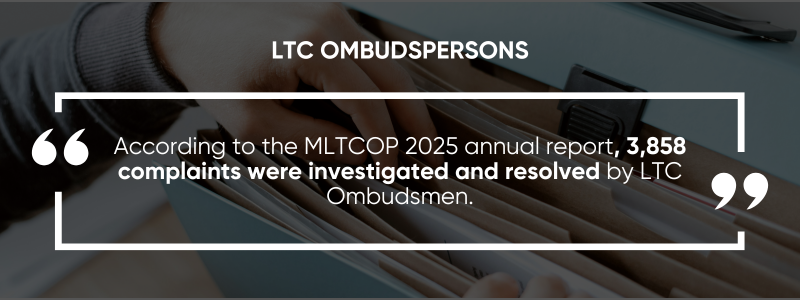
According to the MLTCOP 2025 annual report, 3,858 complaints were investigated and resolved by LTC Ombudsmen. The top three complaint reasons were discharge/eviction (i.e., failure to provide adequate notice, eviction due to inability to pay, retaliation-based discharge if residents or family file complaints), staff failure to respond to requests for assistance, and medications (i.e., being given the incorrect medication or dosage, administering medication without informed consent, and not notifying family of medication errors).⁹⁴ Bridge Michigan’s recent investigation on nursing homes documented nearly 6,000 cases of abuse, neglect, exploitation, or quality of life and care violations among 15,471 total citations.⁹⁵
In addition to individual-level advocacy and problem-solving, MLTCOP attempts to influence policy to improve conditions in LTC overall. The MLTCOP is currently advocating to increase the Personal Needs Allowance (PNA) for Medicaid beneficiaries living in nursing homes to $125,⁹⁶ which has remained at $60 for decades.⁹⁷ MLTCOP has supported past legislation to improve Michigan nursing homes, including one bill that would have given residents the option of installing a camera in their own room.⁹⁸ These efforts, along with investigations, are all aimed at improving the quality of life for LTC residents. Bolstering the LTC Ombudsperson workforce can help protect the health and dignity of aging residents, especially those who need assistance advocating for themselves.
Summary
Michigan is seeking solutions to improve access to healthcare. Community Paramedics, Doulas, Patient Navigators, Dental Therapists, and LTC Ombudspeople are growing occupations with roles particularly impactful in helping individuals from underserved populations and/or areas access care. These five occupations expand clinical expertise, assist in navigating the healthcare system, and advocate to ensure patients receive timely, high-quality healthcare. We should continue to explore how these five occupations can improve healthcare quality and access beyond conventional care in the state of Michigan.

Notes
MHC Insight, “2025 Michigan Healthcare Workforce Index,” July 2025, https://www.mhc.org/_files/ugd/24abcc_06a02541eebb4735b526ea5d9af2e294.pdf.
Health Resources and Services Administration, “Health Workforce Shortage Areas,” Dashboard, May 26, 2026, https://data.hrsa.gov/topics/health-workforce/shortage-areas/dashboard.
Eli Newman, “Five Reasons Health Insurance Rates Are Rising so Much in Michigan,” Bridge Michigan, November 5, 2025, https://bridgemi.com/michigan-health-watch/five-reasons-health-insurance-rates-are-rising-so-much-in-michigan/.
Robin Rudowitz et al., “Medicaid: What to Watch in 2026,” KFF, January 23, 2026, https://www.kff.org/medicaid/medicaid-what-to-watch-in-2026/.
Alan Leach, “The Future of Michigan Seniors: How Baby Boomers Are Reshaping the 65+ Population,” Michigan Center for Data and Analytics, March 2, 2026, https://www.michigan.gov/mcda/population/michigan-population-analysis/2026/03/02/baby-boomers-65plus.
Rural Health Information Hub, “Rural Health Disparities,” September 24, 2025, https://www.ruralhealthinfo.org/topics/rural-health-disparities.
Latoya Hill et al., “Racial Disparities in Maternal and Infant Health: Current Status and Key Issues,” KFF, December 3, 2025, https://www.kff.org/racial-equity-and-health-policy/racial-disparities-in-maternal-and-infant-health-current-status-and-key-issues/.
AARP Michigan, “Disrupting Disparities: The Continuum of Care for Michiganders 50 and Older,” December 2018, https://rockinst.org/wp-content/uploads/2018/12/AARP-Report-Disrupting-Disparities.pdf.
Center for Social Enterprise, Michigan Public Health Institute, “Racial/Ethnic and Geographic Disparities in Behavioral Healthcare in Michigan Medicaid: Final Report and Recommendations,” March 2021, https://mihealthfund.org/wp-content/uploads/2021/06/MPHI-Behavioral-Health-Disparities-Report.pdf.
Bureau of EMS, Trauma & Preparedness, Michigan Department of Health and Human Services, “Community Integrated Paramedicine (CIP),” accessed May 27, 2026, https://www.michigan.gov/mdhhs/inside-mdhhs/legislationpolicy/ems/community-integrated-paramedicine.
Bureau of EMS, Trauma & Preparedness, Michigan Department of Health and Human Services, “Michigan Community Integrated Paramedicine Protocols,” October 28, 2022, https://www.michigan.gov/mdhhs/-/media/Project/Websites/mdhhs/Inside-MDHHS/Policy-and-Planning/EMS/New-Uploads/23-5-30/231222-CIP-Protocol-Suite-102822.pdf?rev=3f25872656504f0c96ef5f71e015a11e.
Rural Health Information Hub, “Community Paramedicine,” January 14, 2026, https://www.ruralhealthinfo.org/topics/community-paramedicine.
Michigan Department of Health and Human Services, “Community Integrated Paramedicine - Frequently Asked Questions,” accessed May 27, 2026, https://www.michigan.gov/mdhhs/inside-mdhhs/legislationpolicy/ems/community-integrated-paramedicine/frequently-asked-questions.
Kellogg Community College, “Emergency Medical Services,” accessed May 29, 2026, https://kellogg.edu/academics/areas-of-study/health-sciences/ems/.
CDC, “The Value of Community Paramedicine,” Emergency Medical Services (EMS) and Community Paramedicine, February 25, 2026, https://www.cdc.gov/ems-community-paramedicine/php/data-research/community-paramedicine/index.html.
Sally C. Curtin and Merianne Rose Spencer, Trends in Death Rates in Urban and Rural Areas: United States, 1999-2019, NCHS Data Brief no. 417 (National Center for Health Statistics, 2021), https://dx.doi.org/10.15620/cdc:109049.
Rural Health Information Hub, “Rural Health Disparities.”
Marvellous Akinlotan et al., “Rural-Urban Variations in Travel Burdens for Care: Findings from the 2017 National Household Travel Survey,” Policy Brief, Southwest Rural Health Research Center, July 2021, https://oaktrust.library.tamu.edu/server/api/core/bitstreams/bdb2f5a7-627b-4bb9-bc86-fb4890cfc9db/content.
Rural residents’ intercity transportation access varies by county. For county-specific data, see Bureau of Transportation Statistics, U.S. Department of Transportation, “Access to Intercity Transportation in Rural Areas,” Interactive Map, September 25, 2023, https://data.bts.gov/stories/s/Rural-Access-to-Intercity-Transportation/gr9y-9gjq/.
Tasha Brown et al., “Rural America’s Senior Citizens: Considerations for Transportation, Healthcare Access, Connectedness, Nutrition and Economics,” Policy Paper, National Rural Health Association, 2020, https://www.ruralhealth.us/getmedia/4f912dad-6a85-4714-9e19-83aadf85d5f5/2020-NRHA-Policy-Document-Rural-America’s-Senior-Citizens.pdf.
Polypharmacy is defined as regular use of at least five medications.
Hyperpolypharmacy is defined as regular use of ten or more medications.
Rural Health Information Hub, “Community Paramedicine Models for Prevention and Health Education,” Online Toolkit, Rural Community Paramedicine Toolkit, 2020, https://www.ruralhealthinfo.org/toolkits/community-paramedicine/2/prevention-and-health-education.
Lisa Van Wilder et al., “Polypharmacy and Health-Related Quality of Life/Psychological Distress Among Patients With Chronic Disease,” Preventing Chronic Disease 19 (2022), https://doi.org/10.5888/pcd19.220062.
Janet Coffman and Connie Kwong, “Left Behind in California: Comparing Community Paramedicine Policies Across States,” CHCF Issue Brief, California Health Care Foundation, November 2019, https://www.chcf.org/wp-content/uploads/2019/11/LeftBehindCaliforniaComparingCommunityParamedicine.pdf.
Coffman and Kwong, “Left Behind in California: Comparing Community Paramedicine Policies Across States.”
S.B. 288, 99th Leg., Reg. Sess. (Mi. 2017). https://www.legislature.mi.gov/documents/2017-2018/billintroduced/Senate/pdf/2017-SIB-0288.pdf.
S.B. 289, 99th Leg., Reg. Sess. (Mi. 2017). https://www.legislature.mi.gov/documents/2017-2018/billintroduced/Senate/pdf/2017-SIB-0289.pdf.
Kathleen Knocke et al., Doula Care and Maternal Health: An Evidence Review, Issue Brief HP-2022-24 (Office of the Assistant Secretary for Planning and Evaluation, U.S. Department of Health and Human Services, 2022), https://aspe.hhs.gov/sites/default/files/documents/dfcd768f1caf6fabf3d281f762e8d068/ASPE-Doula-Issue-Brief-12-13-22.pdf.
Knocke et al., Doula Care and Maternal Health: An Evidence Review.
Michigan Department of Health and Human Services, “Doula Initiative,” accessed May 27, 2026, https://www.michigan.gov/mdhhs/keep-mi-healthy/maternal-and-infant-health/mdhhs-doula-initiative.
Division of Maternal & Infant Health, Michigan Department of Health and Human Services, “Advancing Healthy Births: An Equity Plan for Michigan Families & Communities (2024-2028),” Strategic Plan, October 2023, https://www.michigan.gov/mdhhs/-/media/Project/Websites/mdhhs/Maternal-and-Infant-Health/Advancing-Healthy-Births-Plan-2024-to-2028.pdf?rev=5161a21e79e44506b0fbd4da97788b07&hash=EE0EC09302BB36A4BA8ECF4E27363435.
Meghan E. Groen, Update to Medicaid Coverage of Doula Services, Michigan Medicaid Policy (MMP) Bulletin MMP 24-40 (Behavioral and Physical Health and Aging Services Administration, Michigan Department of Health and Human Services, 2024), https://www.michigan.gov/mdhhs/-/media/Project/Websites/mdhhs/Maternal-and-Infant-Health/Update-to-Medicaid-Coverage-of-Doula-Services-MMP-2440.pdf?rev=11be41e837c04d81abc1c06515f8327a&hash=2061AB7B89A9F09EFE9A42DC80BD5C2F.
Knocke et al., Doula Care and Maternal Health: An Evidence Review.
Meghan A. Bohren et al., “Continuous Support for Women during Childbirth,” The Cochrane Database of Systematic Reviews 7, no. 7 (2017): CD003766, https://doi.org/10.1002/14651858.CD003766.pub6.
Kenneth J. Gruber et al., “Impact of Doulas on Healthy Birth Outcomes,” The Journal of Perinatal Education 22, no. 1 (2013): 49–58, https://doi.org/10.1891/1058-1243.22.1.49.
Knocke et al., Doula Care and Maternal Health: An Evidence Review.
Hill et al., “Racial Disparities in Maternal and Infant Health.”
Hill et al., “Racial Disparities in Maternal and Infant Health.”
March of Dimes, “Maternity Care Desert: Michigan, 2024 Report,” accessed May 28, 2026, https://www.marchofdimes.org/peristats/data?reg=99&top=23&stop=641&lev=1&slev=4&obj=9&sreg=26.
Jasmine Fontenot et al., “Where You Live Matters: Maternity Care Deserts and the Crisis of Access and Equity in Michigan,” Report, March of Dimes, 2023, https://www.marchofdimes.org/peristats/assets/s3/reports/mcd/Maternity-Care-Report-Michigan.pdf.
March of Dimes, “Maternity Care Desert.”
Michigan Department of Health and Human Services Doula Initiative, “Doula Advisory Council,” PowerPoint, October 21, 2025, https://www.michigan.gov/mdhhs/-/media/Project/Websites/mdhhs/Maternal-and-Infant-Health/Doula-Initiative-RG/2025-Doula-Advisory-Council-Meeting-Notes---October.pdf?rev=35abc05e16964fd183d6a6ea45084e6b&hash=223C0A5075864A19825AF4ED12BFBD30.
Jess Mador, “Maternity Care in Rural Areas Is in Crisis. Can More Doulas Help?,” Health Reporting in the States, NPR, July 26, 2024, https://www.npr.org/sections/shots-health-news/2024/07/25/nx-s1-5051862/maternal-rural-mortality-black-women-doulas-pregnant-georgia.
American Hospital Association, “Fact Sheet: Medicaid,” Fact Sheet, American Hospital Association, March 2026, https://www.aha.org/fact-sheets/2026-03-02-fact-sheet-medicaid.
Catherine Marudo et al., “Bridging Health Disparities and Improving Reproductive Outcomes With Health Center–Affiliated Doula Programs,” Obstetrics and Gynecology 142, no. 4 (2023): 886–92, https://doi.org/10.1097/AOG.0000000000005337.
April M. Falconi et al., “Role of Doulas in Improving Maternal Health and Health Equity Among Medicaid Enrollees, 2014‒2023,” American Journal of Public Health 114, no. 11 (2024): 1275–85, https://doi.org/10.2105/AJPH.2024.307805.
Prenatal-to-3 Policy Impact Center Clearinghouse, “Community-Based Doulas: A Proven Solution to Improve Perinatal Outcomes,” Vanderbilt University, April 2023, https://pn3policy.org/wp-content/uploads/2023/04/PN3PIC_CommunityBasedDoulas_Summary.pdf.
National Cancer Institute, National Institutes of Health, U.S. Department of Health and Human Services, “Patient navigator,” in NCI Dictionary of Cancer Terms, February 2, 2011, https://www.cancer.gov/publications/dictionaries/cancer-terms/def/patient-navigator.
Kaye Pestaina, “A 90% Cut to the ACA Navigator Program,” KFF, February 14, 2025, https://www.kff.org/quick-insights/a-90-cut-to-the-aca-navigator-program/.
Karen Politz et al., “2022 Survey of ACA Marketplace Assister Programs and Brokers,” KFF, October 17, 2022, https://www.kff.org/affordable-care-act/2022-survey-of-aca-marketplace-assister-programs-and-brokers/.
Administration for Community Living, U.S. Department of Health and Human Services, “2023 Profile of Older Americans,” Report, U.S. Department of Health and Human Services, May 2024, https://acl.gov/sites/default/files/Profile%20of%20OA/ACL_ProfileOlderAmericans2023_508.pdf.
Administration for Community Living, U.S. Department of Health and Human Services, “2023 Profile of Older Americans.”
U.S. Centers for Medicare & Medicaid Services, “Consumer Assistance Program,” September 10, 2024, https://www.cms.gov/cciio/resources/consumer-assistance-grants.
Michigan Department of Insurance and Financial Services, “Health Insurance,” accessed May 28, 2026, https://www.michigan.gov/difs/consumers/insurance/health-insurance.
Pestaina, “A 90% Cut to the ACA Navigator Program.”
Preethi Rao et al., State-Level Impacts of Key Medicaid Provisions in the One Big Beautiful Bill Act (RAND Corporation, 2026), https://www.rand.org/pubs/research_reports/RRA4098-1.html.
Michigan Department of Health and Human Services, Executive Directive 2025-3 (Michigan Department of Health and Human Services, 2025), https://www.michigan.gov/whitmer/-/media/Project/Websites/Whitmer/Documents/pdf/ED-2025-3-FINAL-%281%29.pdf?rev=67014f6a29814467bad3b8aece15b9a5&hash=0FBBABD5AEF373558239D1C344CBF68D.
American Hospital Association, “Fact Sheet.”
KFF, “Medicaid Enrollees by Urban/Rural Status,” Data Table, n.d., accessed May 28, 2026, https://www.kff.org/medicaid/state-indicator/medicaid-enrollees-by-urban-rural-status/?dataView=1¤tTimeframe=0&selectedDistributions=rural&sortModel=%7B%22colId%22:%22Location%22,%22sort%22:%22asc%22%7D.
Robin Erb, “Report: Michigan to Pay More for Nursing Homes than Most of US — Again,” Bridge Michigan, March 2, 2026, https://bridgemi.com/michigan-health-watch/report-michigan-to-pay-more-for-nursing-homes-than-most-of-us-again/.
Michigan Department of Health and Human Services, Executive Directive 2025-3.
Rao et al., State-Level Impacts of Key Medicaid Provisions in the One Big Beautiful Bill Act.
Justin Lo et al., Claims Denials and Appeals in ACA Marketplace Plans in 2023, Brief (2025), https://www.kff.org/private-insurance/claims-denials-and-appeals-in-aca-marketplace-plans-in-2023/.
Coalition to Strengthen America’s Healthcare, “Holding Corporate Insurers Accountable,” accessed May 28, 2026, https://strengthenhealthcare.org/our-priorities/insurers/.
Gloria D. Coronado et al., “Patient Navigation to Improve Colonoscopy Completion After an Abnormal Stool Test Result,” Annals of Internal Medicine 178, no. 5 (2025): 645–54, https://doi.org/10.7326/ANNALS-24-01885.
Feyikemi Osundina et al., Patient Navigation in Cancer Care: Review of Payment Models for a Sustainable Future (American Cancer Society, 2013), https://chlpi.org/wp-content/uploads/2013/12/Patient-Navigation-in-Cancer-Care-Review-of-Payment-Models_FINAL.pdf.
U.S. Centers for Medicare and Medicaid Services, “Principal Illness Navigation Services,” accessed May 28, 2026, https://www.medicare.gov/coverage/principal-illness-navigation-services.
The Cancer Letter, “CMS Starts Paying for Patient Navigation; ACS Offers Navigation Credentialing Program,” The Cancer Letter, January 5, 2024, https://cancerletter.com/conversation-with-the-cancer-letter/20240105_1/.
U.S. Centers for Medicare and Medicaid Services, “Principal Illness Navigation Services.”
Christopher Pope, “Building Multi-Year Health Insurance,” Health Affairs Forefront, ahead of print, April 3, 2026, https://doi.org/10.1377/forefront.20260402.795193.
Mich. Comp. Law § 333.16651 to 333.16659 (1978). https://www.legislature.mi.gov/documents/2017-2018/publicact/pdf/2018-PA-0463.pdf.
MI Dental Access, “Dental Therapy 101,” accessed May 28, 2026, https://www.midentalaccess.org/dental-therapy-101.
Michigan Department of Health and Human Services, “Michigan Licenses First Dental Therapist to Help Increase Access to Care; Address Workforce Shortages,” Press Release, January 8, 2026, https://www.michigan.gov/mdhhs/inside-mdhhs/newsroom/2026/01/08/dental-therapist.
MI Dental Access, “Information for Current and Aspiring Dental Therapists,” Michigan Primary Care Association, accessed May 28, 2026, https://www.midentalaccess.org/information-for-dental-therapists.
Michigan Department of Health and Human Services, “Michigan Licenses First Dental Therapist to Help Increase Access to Care; Address Workforce Shortages.”
MI Dental Access, “Dental Therapy 101.”
Michigan Oral Health Coalition and Michigan Department of Health and Human Services, “2025 Michigan State Oral Health Plan,” Strategic Plan, June 2021, https://www.michigan.gov/-/media/Project/Websites/mdhhs/Adult-and-Childrens-Services/Children-and-Families/Healthy-Children-and-Healthy-Families/Oral-Health/Resources-Reports-Links/Michigan_State_Oral_Health_Plan_2025.pdf?rev=f0807a5eeb6b42f4ac3ccd1c64447907.
Michigan Department of Health and Human Services, “Michigan Licenses First Dental Therapist to Help Increase Access to Care; Address Workforce Shortages.”
Michigan Oral Health Coalition and Michigan Department of Health and Human Services, “2025 Michigan State Oral Health Plan.”
Michigan Oral Health Coalition and Michigan Department of Health and Human Services, “2025 Michigan State Oral Health Plan.”
Angela Lutz, “Filling Rural Oral Health Care Gaps with Dental Therapists,” Rural Health Voices, March 27, 2025, https://www.ruralhealth.us/blogs/2025/03/filling-rural-oral-health-care-gaps-with-dental-therapists.
Donald L. Chi et al., “Dental Therapists Linked to Improved Dental Outcomes for Alaska Native Communities in the Yukon-Kuskokwim Delta,” Journal of Public Health Dentistry 78, no. 2 (2018): 175–82, https://doi.org/10.1111/jphd.12263.
Courtney M. Hill et al., “Secular Trends in Dental Services Provided by Dental Therapists and Dentists in Southwest Alaska,” Journal of the American Dental Association (1939) 153, no. 12 (2022): 1145–53, https://doi.org/10.1016/j.adaj.2022.08.012.
Donald. L. Chi et al., “Supply of Care by Dental Therapists and Emergency Dental Consultations in Alaska Native Communities in the Yukon-Kuskokwim Delta: A Mixed Methods Evaluation,” Community Dental Health 37, no. 3 (2020): 190–98, https://doi.org/10.1922/CDH_00022Chi09.
National Consumer Voice for Quality Long-Term Care, “About the Ombudsman Program,” The National Long-Term Care Ombudsman Resource Center, accessed May 28, 2026, https://ltcombudsman.org/about/about-ombudsman.
The National Consumer Voice for Quality Long-Term Care, “Michigan Archives,” The National Consumer Voice for Quality Long-Term Care, accessed May 28, 2026, https://theconsumervoice.org/single-location/michigan/.
Michigan Long Term Care Ombudsman Program, FY2025 Annual Report (Michigan Elder Justice Initiative, n.d.), accessed May 28, 2026, https://mltcop.org/documents/fy-2025-annual-mltcop-report.
Michigan Long Term Care Ombudsman Program, “Work With Us,” accessed May 28, 2026, https://mltcop.org/work-us.
Robin Erb and Simon D. Schuster, “Abuse, Neglect Common in Michigan Nursing Homes — and No One Is Coming to Help,” Michigan Health Watch, Bridge Michigan, January 5, 2026, https://bridgemi.com/michigan-health-watch/abuse-neglect-common-in-michigan-nursing-homes-and-no-one-is-coming-to-help/.
KFF, “Total Number of Residents in Certified Nursing Facilities,” Trend Graph, n.d., accessed May 28, 2026, https://www.kff.org/other-health/state-indicator/number-of-nursing-facility-residents/?activeTab=graph¤tTimeframe=0&startTimeframe=10&selectedRows=%7B%22states%22:%7B%22michigan%22:%7B%7D%7D%7D&sortModel=%7B%22colId%22:%22Location%22,%22sort%22:%22asc%22%7D.
Division for Vital Records & Health Statistics, Michigan Department of Health and Human Services, “Total Population by Selected Age Groups: Michigan 2000-2024,” Data Table, n.d., accessed May 28, 2026, https://vitalstats.michigan.gov/osr/Population/npPopAGe.asp.
William H. Frey, “Baby Boomers Are Turning 80,” Brookings, January 7, 2026, https://www.brookings.edu/articles/baby-boomers-are-turning-80/.
Michigan Long Term Care Ombudsman Program, FY2025 Annual Report.
Erb and Schuster, “Abuse, Neglect Common in Michigan Nursing Homes — and No One Is Coming to Help.”
Michigan Long Term Care Ombudsman Program, “Raising the Personal Needs Allowance for Medicaid Nursing Home Residents,” MLTCOP Program Highlights, February 27, 2026, https://mltcop.org/about-us/program-highlights.
In 2026, the average PNA amount was $70.
Robin Erb, “Install Cameras, Beef up Training — and 5 Other Ways to Fix Michigan Nursing Homes,” Michigan Health Watch, Bridge Michigan, January 6, 2026, https://bridgemi.com/michigan-health-watch/install-cameras-beef-up-training-and-5-other-ways-to-fix-michigan-nursing-homes/.
Bibliography
AARP Michigan. “Disrupting Disparities: The Continuum of Care for Michiganders 50 and Older.” December 2018. https://rockinst.org/wp-content/uploads/2018/12/AARP-Report-Disrupting-Disparities.pdf.
Administration for Community Living, U.S. Department of Health and Human Services. “2023 Profile of Older Americans.” Report. U.S. Department of Health and Human Services, May 2024. https://acl.gov/sites/default/files/Profile%20of%20OA/ACL_ProfileOlderAmericans2023_508.pdf.
Akinlotan, Marvellous, Kristin Primm, Nima Khodakarami, Jane Bolin, and Alva O. Ferdinand. “Rural-Urban Variations in Travel Burdens for Care: Findings from the 2017 National Household Travel Survey.” Policy Brief. Southwest Rural Health Research Center, July 2021. https://oaktrust.library.tamu.edu/server/api/core/bitstreams/bdb2f5a7-627b-4bb9-bc86-fb4890cfc9db/content.
American Hospital Association. “Fact Sheet: Medicaid.” Fact Sheet. American Hospital Association, March 2026. https://www.aha.org/fact-sheets/2026-03-02-fact-sheet-medicaid.
Bohren, Meghan A., G. Justus Hofmeyr, Carol Sakala, Rieko K. Fukuzawa, and Anna Cuthbert. “Continuous Support for Women during Childbirth.” The Cochrane Database of Systematic Reviews 7, no. 7 (2017): CD003766. https://doi.org/10.1002/14651858.CD003766.pub6.
Brown, Tasha, Kay Temple Miller, and Josie Rudolphi. “Rural America’s Senior Citizens: Considerations for Transportation, Healthcare Access, Connectedness, Nutrition and Economics.” Policy Paper. National Rural Health Association, 2020. https://www.ruralhealth.us/getmedia/4f912dad-6a85-4714-9e19-83aadf85d5f5/2020-NRHA-Policy-Document-Rural-America’s-Senior-Citizens.pdf.
Bureau of EMS, Trauma & Preparedness, Michigan Department of Health and Human Services. “Community Integrated Paramedicine (CIP).” Accessed May 27, 2026. https://www.michigan.gov/mdhhs/inside-mdhhs/legislationpolicy/ems/community-integrated-paramedicine.
Bureau of EMS, Trauma & Preparedness, Michigan Department of Health and Human Services. “Michigan Community Integrated Paramedicine Protocols.” October 28, 2022. https://www.michigan.gov/mdhhs/-/media/Project/Websites/mdhhs/Inside-MDHHS/Policy-and-Planning/EMS/New-Uploads/23-5-30/231222-CIP-Protocol-Suite-102822.pdf?rev=3f25872656504f0c96ef5f71e015a11e.
Bureau of Transportation Statistics, U.S. Department of Transportation. “Access to Intercity Transportation in Rural Areas.” Interactive Map. September 25, 2023. https://data.bts.gov/stories/s/Rural-Access-to-Intercity-Transportation/gr9y-9gjq/.
CDC. “The Value of Community Paramedicine.” Emergency Medical Services (EMS) and Community Paramedicine, February 25, 2026. https://www.cdc.gov/ems-community-paramedicine/php/data-research/community-paramedicine/index.html.
Center for Social Enterprise, Michigan Public Health Institute. “Racial/Ethnic and Geographic Disparities in Behavioral Healthcare in Michigan Medicaid: Final Report and Recommendations.” March 2021. https://mihealthfund.org/wp-content/uploads/2021/06/MPHI-Behavioral-Health-Disparities-Report.pdf.
Chi, Donald. L., Lloyd Mancl, Scarlett Hopkins, et al. “Supply of Care by Dental Therapists and Emergency Dental Consultations in Alaska Native Communities in the Yukon-Kuskokwim Delta: A Mixed Methods Evaluation.” Community Dental Health 37, no. 3 (2020): 190–98. https://doi.org/10.1922/CDH_00022Chi09.
Chi, Donald L., Dane Lenaker, Lloyd Mancl, Matthew Dunbar, and Michael Babb. “Dental Therapists Linked to Improved Dental Outcomes for Alaska Native Communities in the Yukon-Kuskokwim Delta.” Journal of Public Health Dentistry 78, no. 2 (2018): 175–82. https://doi.org/10.1111/jphd.12263.
Coalition to Strengthen America’s Healthcare. “Holding Corporate Insurers Accountable.” Accessed May 28, 2026. https://strengthenhealthcare.org/our-priorities/insurers/.
Coffman, Janet, and Connie Kwong. “Left Behind in California: Comparing Community Paramedicine Policies Across States.” CHCF Issue Brief. California Health Care Foundation, November 2019. https://www.chcf.org/wp-content/uploads/2019/11/LeftBehindCaliforniaComparingCommunityParamedicine.pdf.
Coronado, Gloria D., Amanda F. Petrik, Jamie H. Thompson, et al. “Patient Navigation to Improve Colonoscopy Completion After an Abnormal Stool Test Result.” Annals of Internal Medicine 178, no. 5 (2025): 645–54. https://doi.org/10.7326/ANNALS-24-01885.
Curtin, Sally C., and Merianne Rose Spencer. Trends in Death Rates in Urban and Rural Areas: United States, 1999-2019. NCHS Data Brief No. 417. National Center for Health Statistics, 2021. https://dx.doi.org/10.15620/cdc:109049.
Division for Vital Records & Health Statistics, Michigan Department of Health and Human Services. “Total Population by Selected Age Groups: Michigan 2000-2024.” Data Table. n.d. Accessed May 28, 2026. https://vitalstats.michigan.gov/osr/Population/npPopAGe.asp.
Division of Maternal & Infant Health, Michigan Department of Health and Human Services. “Advancing Healthy Births: An Equity Plan for Michigan Families & Communities (2024-2028).” Strategic Plan. October 2023. https://www.michigan.gov/mdhhs/-/media/Project/Websites/mdhhs/Maternal-and-Infant-Health/Advancing-Healthy-Births-Plan-2024-to-2028.pdf?rev=5161a21e79e44506b0fbd4da97788b07&hash=EE0EC09302BB36A4BA8ECF4E27363435.
Erb, Robin. “Install Cameras, Beef up Training — and 5 Other Ways to Fix Michigan Nursing Homes.” Michigan Health Watch. Bridge Michigan, January 6, 2026. https://bridgemi.com/michigan-health-watch/install-cameras-beef-up-training-and-5-other-ways-to-fix-michigan-nursing-homes/.
Erb, Robin. “Report: Michigan to Pay More for Nursing Homes than Most of US — Again.” Bridge Michigan, March 2, 2026. https://bridgemi.com/michigan-health-watch/report-michigan-to-pay-more-for-nursing-homes-than-most-of-us-again/.
Erb, Robin, and Simon D. Schuster. “Abuse, Neglect Common in Michigan Nursing Homes — and No One Is Coming to Help.” Michigan Health Watch. Bridge Michigan, January 5, 2026. https://bridgemi.com/michigan-health-watch/abuse-neglect-common-in-michigan-nursing-homes-and-no-one-is-coming-to-help/.
Falconi, April M., Leah Ramirez, Rebecca Cobb, Carrie Levin, Michelle Nguyen, and Tiffany Inglis. “Role of Doulas in Improving Maternal Health and Health Equity Among Medicaid Enrollees, 2014‒2023.” American Journal of Public Health 114, no. 11 (2024): 1275–85. https://doi.org/10.2105/AJPH.2024.307805.
Fontenot, Jasmine, Ripley Lucas, Ashley Stoneburner, et al. “Where You Live Matters: Maternity Care Deserts and the Crisis of Access and Equity in Michigan.” Report. March of Dimes, 2023. https://www.marchofdimes.org/peristats/assets/s3/reports/mcd/Maternity-Care-Report-Michigan.pdf.
Frey, William H. “Baby Boomers Are Turning 80.” Brookings, January 7, 2026. https://www.brookings.edu/articles/baby-boomers-are-turning-80/.
Groen, Meghan E. Update to Medicaid Coverage of Doula Services. Michigan Medicaid Policy (MMP) Bulletin MMP 24-40. Behavioral and Physical Health and Aging Services Administration, Michigan Department of Health and Human Services, 2024. https://www.michigan.gov/mdhhs/-/media/Project/Websites/mdhhs/Maternal-and-Infant-Health/Update-to-Medicaid-Coverage-of-Doula-Services-MMP-2440.pdf?rev=11be41e837c04d81abc1c06515f8327a&hash=2061AB7B89A9F09EFE9A42DC80BD5C2F.
Gruber, Kenneth J., Susan H. Cupito, and Christina F. Dobson. “Impact of Doulas on Healthy Birth Outcomes.” The Journal of Perinatal Education 22, no. 1 (2013): 49–58. https://doi.org/10.1891/1058-1243.22.1.49.
Health Resources and Services Administration. “Health Workforce Shortage Areas.” Dashboard. May 26, 2026. https://data.hrsa.gov/topics/health-workforce/shortage-areas/dashboard.
Hill, Courtney M., Ellen W. MacLachlan, Lloyd A. Mancl, Dane Lenaker, and Donald L. Chi. “Secular Trends in Dental Services Provided by Dental Therapists and Dentists in Southwest Alaska.” Journal of the American Dental Association (1939) 153, no. 12 (2022): 1145–53. https://doi.org/10.1016/j.adaj.2022.08.012.
Hill, Latoya, Alisha Rao, Samantha Artiga, and Usha Ranji. “Racial Disparities in Maternal and Infant Health: Current Status and Key Issues.” KFF, December 3, 2025. https://www.kff.org/racial-equity-and-health-policy/racial-disparities-in-maternal-and-infant-health-current-status-and-key-issues/.
Kellogg Community College. “Emergency Medical Services.” Accessed May 29, 2026. https://kellogg.edu/academics/areas-of-study/health-sciences/ems/.
KFF. “Medicaid Enrollees by Urban/Rural Status.” Data Table. n.d. Accessed May 28, 2026. https://www.kff.org/medicaid/state-indicator/medicaid-enrollees-by-urban-rural-status/?dataView=1¤tTimeframe=0&selectedDistributions=rural&sortModel=%7B%22colId%22:%22Location%22,%22sort%22:%22asc%22%7D.
KFF. “Total Number of Residents in Certified Nursing Facilities.” Trend Graph. n.d. Accessed May 28, 2026. https://www.kff.org/other-health/state-indicator/number-of-nursing-facility-residents/?activeTab=graph¤tTimeframe=0&startTimeframe=10&selectedRows=%7B%22states%22:%7B%22michigan%22:%7B%7D%7D%7D&sortModel=%7B%22colId%22:%22Location%22,%22sort%22:%22asc%22%7D.
Knocke, Kathleen, Andre Chappel, Sarah Sugar, Nancy De Lew, and Benjamin D. Sommers. Doula Care and Maternal Health: An Evidence Review. Issue Brief HP-2022-24. Office of the Assistant Secretary for Planning and Evaluation, U.S. Department of Health and Human Services, 2022. https://aspe.hhs.gov/sites/default/files/documents/dfcd768f1caf6fabf3d281f762e8d068/ASPE-Doula-Issue-Brief-12-13-22.pdf.
Leach, Alan. “The Future of Michigan Seniors: How Baby Boomers Are Reshaping the 65+ Population.” Michigan Center for Data and Analytics, March 2, 2026. https://www.michigan.gov/mcda/population/michigan-population-analysis/2026/03/02/baby-boomers-65plus.
Lo, Justin, Michelle Long, Rayna Wallace, Meghan Salaga, and Kaye Pestaina. Claims Denials and Appeals in ACA Marketplace Plans in 2023. Brief. 2025. https://www.kff.org/private-insurance/claims-denials-and-appeals-in-aca-marketplace-plans-in-2023/.
Lutz, Angela. “Filling Rural Oral Health Care Gaps with Dental Therapists.” Rural Health Voices, March 27, 2025. https://www.ruralhealth.us/blogs/2025/03/filling-rural-oral-health-care-gaps-with-dental-therapists.
Mador, Jess. “Maternity Care in Rural Areas Is in Crisis. Can More Doulas Help?” Health Reporting in the States. NPR, July 26, 2024. https://www.npr.org/sections/shots-health-news/2024/07/25/nx-s1-5051862/maternal-rural-mortality-black-women-doulas-pregnant-georgia.
March of Dimes. “Maternity Care Desert: Michigan, 2024 Report.” Accessed May 28, 2026. https://www.marchofdimes.org/peristats/data?reg=99&top=23&stop=641&lev=1&slev=4&obj=9&sreg=26.
Marudo, Catherine, Caroline Nicotra, Michelle Fletcher, Rhonda Lanning, Melissa Nelson, and Ciara Hancock. “Bridging Health Disparities and Improving Reproductive Outcomes With Health Center–Affiliated Doula Programs.” Obstetrics and Gynecology 142, no. 4 (2023): 886–92. https://doi.org/10.1097/AOG.0000000000005337.
MHC Insight. “2025 Michigan Healthcare Workforce Index.” July 2025. https://www.mhc.org/_files/ugd/24abcc_06a02541eebb4735b526ea5d9af2e294.pdf.
MI Dental Access. “Dental Therapy 101.” Accessed May 28, 2026. https://www.midentalaccess.org/dental-therapy-101.
MI Dental Access. “Information for Current and Aspiring Dental Therapists.” Michigan Primary Care Association. Accessed May 28, 2026. https://www.midentalaccess.org/information-for-dental-therapists.
Michigan Department of Health and Human Services. “Community Integrated Paramedicine - Frequently Asked Questions.” Accessed May 27, 2026. https://www.michigan.gov/mdhhs/inside-mdhhs/legislationpolicy/ems/community-integrated-paramedicine/frequently-asked-questions.
Michigan Department of Health and Human Services. “Doula Initiative.” Accessed May 27, 2026. https://www.michigan.gov/mdhhs/keep-mi-healthy/maternal-and-infant-health/mdhhs-doula-initiative.
Michigan Department of Health and Human Services. Executive Directive 2025-3. Michigan Department of Health and Human Services, 2025. https://www.michigan.gov/whitmer/-/media/Project/Websites/Whitmer/Documents/pdf/ED-2025-3-FINAL-%281%29.pdf?rev=67014f6a29814467bad3b8aece15b9a5&hash=0FBBABD5AEF373558239D1C344CBF68D.
Michigan Department of Health and Human Services. “Michigan Licenses First Dental Therapist to Help Increase Access to Care; Address Workforce Shortages.” Press Release. January 8, 2026. https://www.michigan.gov/mdhhs/inside-mdhhs/newsroom/2026/01/08/dental-therapist.
Michigan Department of Health and Human Services Doula Initiative. “Doula Advisory Council.” PowerPoint. October 21, 2025. https://www.michigan.gov/mdhhs/-/media/Project/Websites/mdhhs/Maternal-and-Infant-Health/Doula-Initiative-RG/2025-Doula-Advisory-Council-Meeting-Notes---October.pdf?rev=35abc05e16964fd183d6a6ea45084e6b&hash=223C0A5075864A19825AF4ED12BFBD30.
Michigan Department of Insurance and Financial Services. “Health Insurance.” Accessed May 28, 2026. https://www.michigan.gov/difs/consumers/insurance/health-insurance.
Michigan Long Term Care Ombudsman Program. FY2025 Annual Report. Michigan Elder Justice Initiative, n.d. Accessed May 28, 2026. https://mltcop.org/documents/fy-2025-annual-mltcop-report.
Michigan Long Term Care Ombudsman Program. “Raising the Personal Needs Allowance for Medicaid Nursing Home Residents.” MLTCOP Program Highlights, February 27, 2026. https://mltcop.org/about-us/program-highlights.
Michigan Long Term Care Ombudsman Program. “Work With Us.” Accessed May 28, 2026. https://mltcop.org/work-us.
Michigan Oral Health Coalition and Michigan Department of Health and Human Services. “2025 Michigan State Oral Health Plan.” Strategic Plan. June 2021. https://www.michigan.gov/-/media/Project/Websites/mdhhs/Adult-and-Childrens-Services/Children-and-Families/Healthy-Children-and-Healthy-Families/Oral-Health/Resources-Reports-Links/Michigan_State_Oral_Health_Plan_2025.pdf?rev=f0807a5eeb6b42f4ac3ccd1c64447907.
National Cancer Institute, National Institutes of Health, U.S. Department of Health and Human Services. “Patient navigator.” In NCI Dictionary of Cancer Terms. February 2, 2011. https://www.cancer.gov/publications/dictionaries/cancer-terms/def/patient-navigator.
National Consumer Voice for Quality Long-Term Care. “About the Ombudsman Program.” The National Long-Term Care Ombudsman Resource Center. Accessed May 28, 2026. https://ltcombudsman.org/about/about-ombudsman.
Newman, Eli. “Five Reasons Health Insurance Rates Are Rising so Much in Michigan.” Bridge Michigan, November 5, 2025. https://bridgemi.com/michigan-health-watch/five-reasons-health-insurance-rates-are-rising-so-much-in-michigan/.
Osundina, Feyikemi, Katie Garfield, and Sarah Downer. Patient Navigation in Cancer Care: Review of Payment Models for a Sustainable Future. American Cancer Society, 2013. https://chlpi.org/wp-content/uploads/2013/12/Patient-Navigation-in-Cancer-Care-Review-of-Payment-Models_FINAL.pdf.
Pestaina, Kaye. “A 90% Cut to the ACA Navigator Program.” KFF, February 14, 2025. https://www.kff.org/quick-insights/a-90-cut-to-the-aca-navigator-program/.
Politz, Karen, Jennifer Tolbert, Kaye Pestaina, and Salem Mengistu. “2022 Survey of ACA Marketplace Assister Programs and Brokers.” KFF, October 17, 2022. https://www.kff.org/affordable-care-act/2022-survey-of-aca-marketplace-assister-programs-and-brokers/.
Pope, Christopher. “Building Multi-Year Health Insurance.” Health Affairs Forefront, ahead of print, April 3, 2026. https://doi.org/10.1377/forefront.20260402.795193.
Prenatal-to-3 Policy Impact Center Clearinghouse. “Community-Based Doulas: A Proven Solution to Improve Perinatal Outcomes.” Vanderbilt University, April 2023. https://pn3policy.org/wp-content/uploads/2023/04/PN3PIC_CommunityBasedDoulas_Summary.pdf.
Rao, Preethi, Lawrence Baker, Federico Girosi, Elaine Li, Rose Kerber, and Christine Eibner. State-Level Impacts of Key Medicaid Provisions in the One Big Beautiful Bill Act. RAND Corporation, 2026. https://www.rand.org/pubs/research_reports/RRA4098-1.html.
Rudowitz, Robin, Alice Burns, Elizabeth Hinton, Jennifer Tolbert, and Elizabeth Williams. “Medicaid: What to Watch in 2026.” KFF, January 23, 2026. https://www.kff.org/medicaid/medicaid-what-to-watch-in-2026/.
Rural Health Information Hub. “Community Paramedicine.” January 14, 2026. https://www.ruralhealthinfo.org/topics/community-paramedicine.
Rural Health Information Hub. “Community Paramedicine Models for Prevention and Health Education.” Online Toolkit. Rural Community Paramedicine Toolkit, 2020. https://www.ruralhealthinfo.org/toolkits/community-paramedicine/2/prevention-and-health-education.
Rural Health Information Hub. “Rural Health Disparities.” September 24, 2025. https://www.ruralhealthinfo.org/topics/rural-health-disparities.
The Cancer Letter. “CMS Starts Paying for Patient Navigation; ACS Offers Navigation Credentialing Program.” The Cancer Letter, January 5, 2024. https://cancerletter.com/conversation-with-the-cancer-letter/20240105_1/.
The National Consumer Voice for Quality Long-Term Care. “Michigan Archives.” The National Consumer Voice for Quality Long-Term Care. Accessed May 28, 2026. https://theconsumervoice.org/single-location/michigan/.
U.S. Centers for Medicare & Medicaid Services. “Consumer Assistance Program.” September 10, 2024. https://www.cms.gov/cciio/resources/consumer-assistance-grants.
U.S. Centers for Medicare and Medicaid Services. “Principal Illness Navigation Services.” Accessed May 28, 2026. https://www.medicare.gov/coverage/principal-illness-navigation-services.
Wilder, Lisa Van, Brecht Devleesschauwer, Els Clays, Peter Pype, Sophie Vandepitte, and Delphine De Smedt. “Polypharmacy and Health-Related Quality of Life/Psychological Distress Among Patients With Chronic Disease.” Preventing Chronic Disease 19 (2022). https://doi.org/10.5888/pcd19.220062.

Comments